Author name: Muhammad Zohaib Sardar

Download Instagram Videos and Reels on Mac (Free, No Watermark)
Blog

How to Download Instagram Videos and Reels on Mac

Instagram restricts video downloads through a deliberate platform choice: no save button exists on the Instagram desktop site, the mobile app saves only to Instagram’s own internal storage, and Stories disappear within 24 hours. Mac users wanting MP4 files of Reels for repurposing, Stories for archival, or feed videos for content research need a route Instagram doesn’t provide. TubeFetcher downloads Instagram videos, Reels, Stories, and IGTV on Mac as clean MP4 files with no account, no subscription, and no ads. This guide covers the four methods that work on macOS, the content types each handles, and where the desktop app approach fits versus command-line or browser alternatives.  Why Instagram makes video downloads on Mac difficult Instagram restricts downloads through three structural choices that affect every Mac user trying to save a video. Unlike YouTube’s Premium offline cache or TikTok’s watermarked save, Instagram offers no native download path for viewers on macOS. Three friction points define the Instagram Mac download problem: The combination means Mac users hit a hard wall on every Instagram content type: feed videos, Reels, Stories, IGTV, and Live replays. The methods below cover the routes that produce an actual MP4 file. Method 1: Download Instagram videos on Mac with TubeFetcher TubeFetcher is the recommended Mac route for clean Instagram MP4 downloads. The Universal build runs on Intel and Apple Silicon Macs and handles every Instagram content type: feed videos, Reels, IGTV, Stories from public accounts, and Live replays where available. No Instagram account required, no subscription, no ads. The four-step Mac flow: TubeFetcher handles Reels at the source vertical 9:16 ratio, feed videos in 1:1 square or 4:5 portrait, and IGTV in 9:16 vertical. The output is a standard MP4 file that imports into Final Cut Pro, DaVinci Resolve, Adobe Premiere, Photoshop, and any standard Mac video player. No watermark, no Instagram branding, no re-upload step. Download TubeFetcher for your operating system: 100,000+ users in 30+ countries run TubeFetcher today. For first-run setup on macOS, the TubeFetcher how-to guide covers installation and the first download. Why TubeFetcher fits Instagram content specifically Instagram Mac downloaders fall into three categories: web converters (ad-heavy, often broken after Instagram API changes), browser extensions (often abandoned or removed from Chrome Web Store), and desktop apps. TubeFetcher fits the third category with four properties that matter for Instagram content: The combination makes TubeFetcher the trusted Mac Instagram download path for content creators, marketers, and designers archiving Instagram content regularly. Method 2: Instagram’s native “Save” feature (limited) Instagram’s built-in Save feature stores posts to a Collection inside the Instagram mobile app. The Mac desktop site shows the same Save icon, but the saved post remains inside Instagram, no MP4 file extracts to the user’s Mac. The Instagram Save process uses three steps: Use Instagram’s native Save when bookmarking the post inside the app is enough, coming back to a Reel later, building a private Collection for reference, or organizing Saved posts by Collection name. Skip this route when an actual MP4 file on the Mac is the goal. Method 3: yt-dlp for command-line Mac users yt-dlp downloads Instagram videos on Mac through Terminal. The tool handles public Instagram posts, Reels, IGTV, and Stories where the user has legitimate access. Install via Homebrew: brew install yt-dlp ffmpeg Download an Instagram post or Reel: yt-dlp “https://www.instagram.com/p/POST_ID/” Download an Instagram Reel specifically: yt-dlp “https://www.instagram.com/reel/REEL_ID/” Download an Instagram user’s recent posts (where permissions allow): yt-dlp “https://www.instagram.com/USERNAME/” yt-dlp updates regularly and tracks Instagram’s API changes faster than any GUI tool. The trade-off is Terminal, for a paste-and-click workflow without command syntax, TubeFetcher delivers the same MP4 output. Method 4: Browser-based Instagram downloaders Web converters extract Instagram videos through sites that accept an Instagram URL and return an MP4 file. Tools like SnapInsta, FastDl, and SaveFrom sit in this category. Three real limits apply on Instagram specifically: Use browser routes for one-off public Instagram videos when no install is acceptable. Skip them for Reels you plan to edit, Stories you want to archive, or any private content. Instagram content types: how each method handles them The content-type behavior splits cleanly by method, which decides which approach fits a given use case. Method Reels Feed videos IGTV Stories Live replays TubeFetcher Yes Yes Yes Public only Where available Instagram’s native Save In-app only In-app only In-app only In-app only No yt-dlp Yes Yes Yes Where accessible Where available Browser converter Often Often Sometimes No No For Mac users repurposing Instagram content for editing or cross-platform sharing, TubeFetcher and yt-dlp produce comparable MP4 output across content types. The difference is workflow, TubeFetcher requires no Terminal. Five Mac workflows for Instagram video downloads The desktop app approach fits five specific Mac scenarios where Instagram MP4 access matters most. Content creators repurposing Reels for other platforms Mac creators cross-posting Reels to TikTok, YouTube Shorts, and X need clean source MP4 files without the Instagram watermark or aspect-ratio re-encoding. TubeFetcher’s source-resolution output drops into video editors at the original 9:16 ratio. Marketers researching competitor Instagram strategy Brand teams analyzing competitor Reels, story sequences, and feed video performance pull MP4 files for slide decks, internal reports, and trend research. The single-app workflow speeds up the per-account competitor sweep without logging into Instagram. Designers archiving inspiration boards Designers building motion design references collect Instagram Reels alongside Vimeo professional work and TikTok trends. The clean MP4 output imports into Figma, After Effects, and Cinema 4D for animation study. Educators saving public educational Reels Teachers saving language-learning Reels, science explanation videos, and tutorial content build offline libraries for classroom use. The MP4 plays in any media player without requiring Instagram access during teaching. Users archiving expiring Stories Stories disappear in 24 hours unless the creator saves them to Highlights. Viewers who want to archive a public Story before it vanishes, for personal reference, design inspiration, or news context, need a route Instagram does not provide natively. How to start downloading Instagram videos on Mac today The setup takes three steps: Never enter your Instagram password into a third-party
Download SoundCloud Tracks as MP3 on Mac (Free, No Account)
Blog

How to Download SoundCloud Tracks as MP3 on Mac

SoundCloud hosts music, DJ mixes, podcasts, and remixes, but many tracks cannot be saved through SoundCloud’s own offline feature, which requires SoundCloud Go+ at $9.99 per month and locks files inside the SoundCloud app on mobile only. Mac users wanting MP3 files for offline DJ sets, podcast archives, or workout playlists need a different route. TubeFetcher downloads SoundCloud tracks as MP3 files on Mac at the source bitrate with no account, no subscription, and no ads. This guide covers the four methods that work on macOS, the audio bitrate each produces, and where the desktop app approach fits versus command-line or browser routes.  Why downloading SoundCloud tracks on Mac is harder than it looks SoundCloud restricts downloads through three structural choices that affect every Mac user trying to save a track. The default streaming experience plays through the browser or the SoundCloud desktop site, but the file itself stays on SoundCloud’s servers. Three friction points define the SoundCloud Mac download problem: The combination means Mac users hit a download wall on most SoundCloud tracks they actually want to save. The methods below cover the routes that produce a real MP3 file. Method 1: Download SoundCloud tracks as MP3 on Mac with TubeFetcher TubeFetcher is the recommended Mac route for SoundCloud MP3 downloads. The Universal build runs on Intel and Apple Silicon Macs and extracts audio from SoundCloud’s HLS streams at the bitrate the source provides. No account, no subscription, no ads. The four-step Mac flow: TubeFetcher handles SoundCloud tracks, full mixes, podcast episodes, and DJ sets that exceed one hour. The output is a standard MP3 file that plays in Apple Music, Spotify’s local files feature, VLC, Rekordbox, Serato, and any DJ software. ID3 metadata transfers automatically where the artist included it in the upload. Download TubeFetcher for your operating system: 100,000+ users in 30+ countries run TubeFetcher today. For first-run setup on macOS, the TubeFetcher how-to guide covers installation and the first download. Why TubeFetcher fits SoundCloud audio specifically SoundCloud Mac downloaders fall into three categories: web converters (ad-heavy, often broken on HLS streams), browser extensions (limited, often abandoned after SoundCloud API changes), and desktop apps. TubeFetcher fits the third category with four properties that matter for SoundCloud audio: The combination makes TubeFetcher the trusted Mac SoundCloud download path for DJs, podcasters, and music collectors who save tracks regularly. Method 2: SoundCloud’s own download button (when enabled) SoundCloud’s built-in download button works on tracks where the artist has enabled the option. The button sits below the waveform on the track page, marked with a downward arrow icon. The official process uses three steps: The file downloads in the format the artist uploaded, usually MP3, sometimes WAV or FLAC for higher-quality uploads. The button does not appear on tracks where the artist has disabled downloads, which covers most professional uploads. For those tracks, the methods below apply. Method 3: yt-dlp for command-line Mac users yt-dlp downloads SoundCloud tracks as MP3 on Mac through Terminal. The tool extracts audio from SoundCloud’s HLS streams at the source bitrate. Install via Homebrew: brew install yt-dlp ffmpeg Download a single SoundCloud track as MP3: yt-dlp -x –audio-format mp3 –audio-quality 0 “TRACK_URL” Download a SoundCloud playlist or DJ mix series: yt-dlp -x –audio-format mp3 “PLAYLIST_URL” Download a full SoundCloud user’s tracks (where rights permit): yt-dlp -x –audio-format mp3 “https://soundcloud.com/USERNAME/tracks” The –audio-quality 0 flag pulls the highest available bitrate. yt-dlp updates almost daily and tracks SoundCloud’s API changes faster than any GUI tool. The trade-off is Terminal, for a paste-and-click workflow, TubeFetcher delivers the same MP3 quality without command syntax. Method 4: Browser-based SoundCloud downloaders Web converters extract SoundCloud tracks through sites that accept a track URL and return an MP3 file. Tools like SoundCloudMP3, KlickAud, and SCDownloader sit in this category. Three real limits apply on SoundCloud specifically: Use browser routes for one-off public SoundCloud tracks where the bitrate is acceptable. Skip them for DJ sets, podcast archives, or any track you plan to use in production. SoundCloud MP3 quality: what bitrate each method delivers The bitrate behavior splits cleanly by method, which decides which approach fits a given use case. Method Max bitrate Source quality preserved Bulk capable TubeFetcher Source bitrate Yes Yes SoundCloud’s own download Source bitrate Yes No yt-dlp Source bitrate Yes Yes Browser converter Often 128 kbps No (re-encoded) No SoundCloud uploads sit at 128 kbps on free accounts and up to 256 kbps on Pro Unlimited. TubeFetcher and yt-dlp both pull the source bitrate without re-encoding, which preserves the audio quality the artist uploaded. Browser converters typically re-encode to a lower bitrate, which compounds compression loss. Five Mac use cases for SoundCloud MP3 downloads The desktop app approach fits five specific Mac workflows where SoundCloud MP3 access matters most. DJs building offline libraries Mac DJs running Rekordbox, Serato, or Traktor preview tracks from SoundCloud and pull them as MP3 for set preparation. Source-bitrate MP3 from TubeFetcher imports cleanly into DJ software without re-encoding artifacts that affect tempo detection and key analysis. Podcast listeners saving episodes Podcast subscribers archiving long-form episodes from SoundCloud need files that survive the show’s eventual deletion from the platform. TubeFetcher saves full episodes, including episodes over three hours, as single MP3 files for offline listening. Producers sampling reference tracks Music producers studying production techniques download reference tracks for tempo analysis, key detection, and arrangement study. The MP3 imports into Ableton Live, Logic Pro, and Pro Tools as audio reference. Travelers building offline playlists Mac users preparing for flights or low-connectivity regions build offline music libraries from SoundCloud independent releases that Spotify and Apple Music do not carry. TubeFetcher saves the MP3 locally, which plays in any media player. Educators archiving lecture audio Teachers and students saving lecture recordings, audiobook excerpts, and language learning material from SoundCloud need permanent local copies. The MP3 output works offline and survives any later removal from SoundCloud. How to start downloading SoundCloud MP3 on Mac today The setup takes three steps: Never enter your SoundCloud password into a third-party app.

Save Videos from Multiple Platforms on Mac (YouTube, Vimeo, TikTok, Instagram)
Blog

How to Save Videos from Multiple Platforms on Mac (One App for YouTube, Vimeo, TikTok, Instagram)

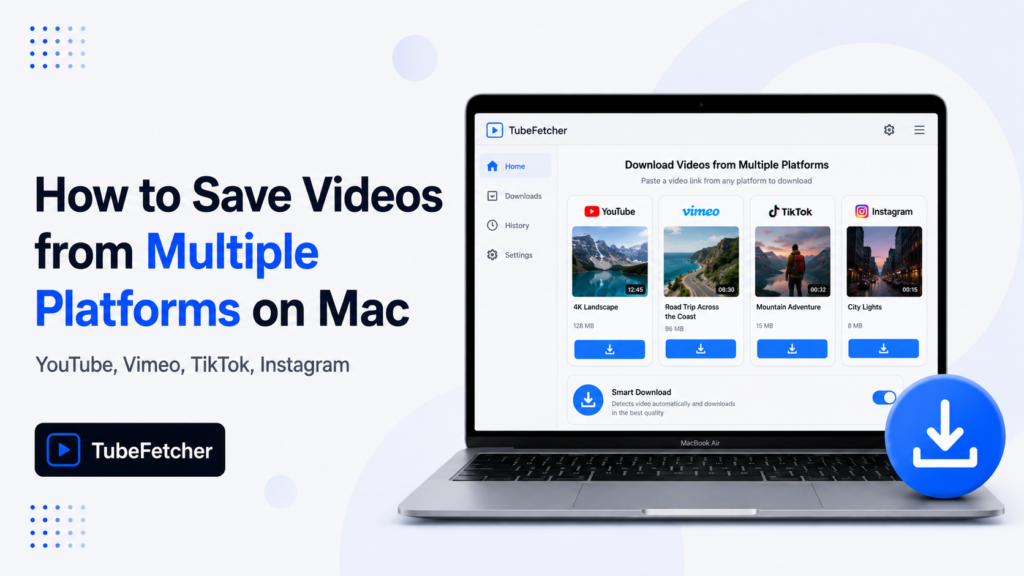
Mac users saving videos from YouTube, Vimeo, TikTok, and Instagram in the same week often install four separate apps. Each app comes with its own ads, its own privacy posture, and its own update cycle. TubeFetcher consolidates the workflow into one Mac app that downloads MP4 video and MP3 audio from 19+ platforms through the same paste-and-download flow. This guide covers the multi-platform Mac workflow, which platforms TubeFetcher handles, and where the single-app approach fits best for creators, students, and remote workers.  Why one Mac app beats five separate platform downloaders Mac users running platform-specific downloaders hit the same five problems. A YouTube tool fails on Vimeo. A Vimeo tool ignores TikTok. A TikTok converter adds a watermark. An Instagram extension breaks after platform updates. A SoundCloud downloader sits unused most weeks. The fragmentation creates four concrete costs: TubeFetcher solves the fragmentation with one Mac app that handles every major platform through the same four-step flow. The Universal binary runs on Intel and Apple Silicon. The local-only architecture means no file routes through external servers, on any supported platform. How TubeFetcher handles multi-platform downloads on Mac TubeFetcher uses the same paste-and-download workflow across every supported platform. The consistency removes the per-platform relearn cost that comes with managing separate tools. The four-step Mac flow: The same four steps work whether the source is a YouTube tutorial, a Vimeo film reference, a TikTok trend clip, or an Instagram Reel. TubeFetcher recognizes the URL pattern and applies the correct stream extractor automatically. Download TubeFetcher for your operating system: 100,000+ users in 30+ countries run TubeFetcher today. For first-run setup on macOS, the TubeFetcher how-to guide covers installation and the first download. Which platforms does TubeFetcher support on Mac TubeFetcher downloads from 19+ platforms across four content categories on macOS. The categories are sorted by content type, which fits the way Mac users actually organize their saves. Video platforms The video category covers long-form, professional, and creator-focused content. TubeFetcher delivers MP4 files at source resolution, up to the quality each platform provides. Music platforms The music category covers audio-first content where Mac users save tracks, podcasts, mixes, and DJ sets. TubeFetcher extracts MP3 audio at the bitrate the source provides. Social platforms The social category covers short-form, mobile-first, and feed-based content. TubeFetcher downloads MP4 video from each platform’s native share URLs. Five Mac workflows that benefit most from one downloader The multi-platform approach fits five specific Mac user types whose source content lives across more than one site. Content creators repurposing across platforms Creators editing short-form content draw reference from TikTok trends, Instagram Reels, and Vimeo for professional inspiration. TubeFetcher pulls clean MP4 files from each source, TikTok without the watermark, Instagram at source resolution, Vimeo where the creator has enabled access. The unified Mac workflow keeps reference clips organized in one folder structure instead of three. Students saving lectures from multiple sources University coursework often spans YouTube tutorials, professor-uploaded Vimeo lectures, Bilibili tutorials for language study, and Loom recordings for project handoffs. TubeFetcher saves all four to the same local library, which fits offline study during travel or low-connectivity periods. The companion private and unlisted YouTube guide for Mac covers the permission-based workflow for class-restricted content. Remote workers building offline libraries Distributed teams move training content across YouTube channels, Loom screen recordings, and Vimeo professional series. Remote workers preparing for flights, low-bandwidth regions, or focused work blocks need offline access to all three. TubeFetcher saves each as a portable MP4, which plays in QuickTime, VLC, and any standard Mac video player. Marketers researching competitor content Brand teams analyzing competitor video strategy track content across YouTube long-form, TikTok shorts, Instagram Reels, and X video posts. TubeFetcher pulls the source MP4 from each platform without leaving an account trail, which preserves research privacy. The single-app workflow speeds up the per-platform competitor sweep. Designers archiving inspiration Designers building mood boards collect video reference from Vimeo motion design portfolios, YouTube animation tutorials, and Dribbble-shared TikTok clips. TubeFetcher’s MP4 output drops directly into Final Cut Pro, DaVinci Resolve, After Effects, and Figma’s video frames, no re-encoding required. Where the multi-platform approach fits less well Three cases call for a platform-specific approach instead: For these edge cases, the specialized approach fits better than the general multi-platform Mac workflow. How to start the multi-platform Mac workflow today The setup takes three steps: Never enter passwords for YouTube, Vimeo, TikTok, Instagram, or any other platform into a third-party app. Legitimate Mac downloaders use public URLs and your browser session, they do not require platform credentials. Related Mac download guides For platform-specific deep dives that go beyond the multi-platform workflow above: Frequently Asked Questions Can one Mac app really download from 19+ platforms? Yes. TubeFetcher’s unified extractor handles 19+ platforms including YouTube, Vimeo, TikTok, Instagram, X, Facebook, Reddit, Twitch, Dailymotion, Bilibili, Rumble, BitChute, Naver, Flickr, Streamable, Loom, Odysee, SoundCloud, and Bandcamp through the same paste-and-download flow. Does TubeFetcher work on Intel and Apple Silicon Macs? Yes. The Universal binary runs natively on both Intel Macs and Apple Silicon Macs (M1, M2, M3, M4). The same feature set and 19+ platform support exist on both architectures. Will multi-platform downloads slow down my Mac? No. TubeFetcher uses native Mac architecture rather than Electron, which keeps memory and CPU usage low. Downloads run in the background while other Mac apps stay responsive. Can I extract MP3 from any of the supported platforms? Yes. TubeFetcher extracts MP3 audio from YouTube, Vimeo, SoundCloud, Bandcamp, and other audio-capable platforms at the bitrate the source provides. The same MP3 extraction works across all 19+ supported sites. Does TubeFetcher require an account on each platform? No. TubeFetcher requires no account on any of the 19+ supported platforms. The app downloads from public URLs and uses your existing browser session for content where authentication applies.

Download Vimeo Videos on Mac (Public, Private, and Password-Protected)
Blog

How to Download Vimeo Videos on Mac

Vimeo downloads on Mac depend on a setting the creator controls, not the viewer. Each uploader decides whether the official download button appears on their video. Most professional creators turn it off. When the button is missing, Mac users need a different route.  TubeFetcher for a one-click MP4 or MP3, Vimeo’s own download button when available, yt-dlp for password-protected content, or a browser workaround for short public clips.  This guide covers each method, the file types it produces, and the cases where Vimeo’s stronger anti-scraping rules break tools that work fine on YouTube.  Why Vimeo videos are harder to download than YouTube Vimeo treats download permission as a per-video setting controlled by the uploader. Vimeo Plus, Pro, and Business accounts can enable the download button on individual uploads. Most creators leave it off on portfolio reels, paid content, and client work. Three structural differences separate Vimeo downloads from YouTube downloads: These three differences mean Mac users hit the “Download Vimeo videos” question with stricter constraints than the “download YouTube videos” question. Tools that handle YouTube on Mac sometimes fail on Vimeo. Method 1: Vimeo’s built-in download button Vimeo’s official download button is the cleanest route when the creator has enabled it. The button appears under the video player or inside the share menu on supported videos. The official process uses three steps: The file saves to your Mac’s Downloads folder as an .mp4. No third-party tool, no install, no account on the viewer’s side. Vimeo confirms creator-uploaded videos download at the highest resolution available, up to the original master file on Vimeo Plus and higher tiers. The button does not appear if the creator has disabled downloads. For those videos, the methods below apply. Method 2: Download Vimeo videos on Mac with TubeFetcher TubeFetcher is the recommended Mac route for Vimeo downloads when the official button is missing. The app handles public Vimeo videos, embedded Vimeo players on third-party sites, and Vimeo content where the user has legitimate access. The Universal build runs on Intel and Apple Silicon Macs. No account required, no subscription, no ads, no tracking. The download process uses four steps: TubeFetcher solves the friction the Vimeo permission model creates. The official button works on roughly half of public Vimeo videos in practice. TubeFetcher fills the other half, portfolio reels, paid course videos the user has access to, embedded Vimeo on sites the user owns, and any video where the creator has disabled the public download button. The same Universal build also downloads YouTube, which fits Mac users who want one tool for both platforms instead of two separate apps. Use the methods authorized by the content owner or by your own permission to access the file. TubeFetcher is available across four operating systems: 100,000+ users in 30+ countries run TubeFetcher today. For first-run setup on macOS, the TubeFetcher how-to guide covers installation and the first download. Method 3: yt-dlp for advanced Vimeo workflows yt-dlp downloads every category of Vimeo video that user permissions allow: public, embedded, password-protected, and Showcase. The trade-off is Terminal. Install on Mac via Homebrew: brew install yt-dlp ffmpeg Download a public Vimeo video: yt-dlp “https://vimeo.com/VIDEO_ID” Download a password-protected Vimeo video (with the creator’s password): yt-dlp –video-password “PASSWORD” “https://vimeo.com/VIDEO_ID” Download an embedded Vimeo video from a site that uses the Vimeo player: yt-dlp “https://player.vimeo.com/video/VIDEO_ID” The –video-password flag passes the creator-set password directly to Vimeo’s authentication, so the file downloads in original quality without browser scraping. yt-dlp updates almost daily and tracks Vimeo’s stream changes faster than any GUI tool. Method 4: Browser-based Vimeo downloaders Browser converters extract Vimeo videos through web tools that take a Vimeo URL and return a .mp4 file. The method suits public Vimeo videos when no installation is acceptable. Three real limits apply to Vimeo specifically: Use browser routes for short, public Vimeo clips. Skip them for password-protected, private, or paid content. How to download password-protected Vimeo videos on Mac Password-protected Vimeo videos require the password from the creator. The route splits by tool: Password-protected Vimeo links share the same workflow as private YouTube content, both require legitimate access from the content owner before download. For the YouTube equivalent, the private and unlisted YouTube guide for Mac covers the same permission-based principle. Never enter your Vimeo password into a third-party app; legitimate tools authenticate through your browser session, not your password. Never share creator-set video passwords outside the people the creator authorized. Which method fits your Vimeo download Match the method to the type of Vimeo video and your comfort with Terminal: Related video download guides For other download tasks across YouTube and Mac, the specific guides go deeper than this one: Frequently Asked Questions Why doesn’t Vimeo have a download button on every video? Vimeo creators choose whether to enable downloads on each video. Vimeo Plus, Pro, and Business accounts can toggle the setting per upload. Most professional uploads, paid content, and client review links have downloads disabled. Can I download a private Vimeo video on a Mac? Yes, when you have legitimate access to the video. yt-dlp handles password-protected Vimeo through the –video-password flag. Browser converters cannot pass Vimeo authentication. Does Vimeo’s download button work in Safari? Yes. Vimeo’s official download button works in Safari, Chrome, Firefox, and Edge on Mac. The button appears only when the creator has enabled downloads on that specific video. What format does Vimeo download in? Vimeo’s official download button delivers MP4 files at the resolutions the creator made available, up to the original master file on Plus and higher tiers. Third-party tools save Vimeo as an MP4 in the resolution selected at download time. Can I download an embedded Vimeo video on a Mac? Yes. Embedded Vimeo videos download through yt-dlp using the https://player.vimeo.com/video/VIDEO_ID URL format. The player URL points to the underlying Vimeo file rather than the embedding site’s wrapper.

Download TikTok Videos on Mac Without Watermark
Blog

How to Download TikTok Videos on Mac Without a Watermark

TikTok adds a watermark to every video saved through its own download button. The watermark contains the TikTok logo and the creator’s username overlaid in two corners of the video, rotating positions throughout the clip. Mac users repurposing TikTok content for editing, archival, or cross-platform sharing need a route that bypasses the watermark.  TubeFetcher downloads TikTok videos on Mac as clean MP4 files with no watermark, no account, and no ads. This guide covers the four methods that work on macOS, the watermark behavior of each, and the cases where TikTok’s own download is the right choice. Download only content you have the right or permission to save. For the full position, see our guide on whether downloading videos is legal. Why TikTok adds a watermark to every download TikTok applies a watermark to every video saved through its native download button on both mobile and desktop. The watermark serves TikTok’s platform-brand visibility, not the creator’s signature; the creator’s username already appears in the video’s caption and profile link. The watermark moves position throughout the clip to prevent cropping it out cleanly. Three structural facts shape the Mac TikTok download problem: Mac users editing TikTok clips, archiving content for a portfolio, or repurposing trends for other platforms need a clean MP4 file. The methods below produce that file in different ways. Method 1: Download TikTok videos on Mac with TubeFetcher TubeFetcher is the recommended Mac route for clean, watermark-free TikTok downloads. The Universal build runs on Intel and Apple Silicon Macs. No account, no subscription, no ads, no tracking. The download process uses four steps: TubeFetcher handles TikTok public videos, including standard clips, longer-form content, and TikTok LIVE replays where available. The same Universal build downloads from YouTube, Vimeo, Instagram, X, and 15+ other platforms, which fits Mac users managing video saves from multiple sources in one app. Download TubeFetcher for your operating system: 100,000+ users in 30+ countries run TubeFetcher today. For the first-run setup, the TubeFetcher how-to guide covers installation on macOS. What makes TubeFetcher different on TikTok specifically TikTok-specific Mac downloaders fall into three categories: web converters (ad-heavy, often broken), browser extensions (limited, often abandoned), and desktop apps. TubeFetcher fits the third category with four properties that matter for TikTok content: The combination makes TubeFetcher the trusted Mac TikTok download path for users who repurpose, edit, or archive TikTok content regularly. Method 2: TikTok’s own download button (watermarked) TikTok’s built-in download button works on most public TikTok videos through both the mobile app and the desktop website. The button is the official route, no third-party tool, no install. The trade-off is the watermark on every download. The TikTok download process uses three steps: Use TikTok’s own download when watermark visibility is acceptable, saving a clip for personal reference, reposting on a platform where the TikTok watermark is expected, or capturing a video the creator has explicitly asked viewers to share. Skip this route when the file needs to be clean for editing or cross-platform repurposing. Method 3: yt-dlp for command-line Mac users yt-dlp downloads TikTok videos on Mac without the watermark through Terminal. The tool is open-source, free, and updates daily to track TikTok’s stream changes. Install via Homebrew: brew install yt-dlp ffmpeg Download a TikTok video: yt-dlp “https://www.tiktok.com/@username/video/VIDEO_ID” Download a TikTok video at a specific resolution: yt-dlp -f “best[height<=1080]” “https://www.tiktok.com/@username/video/VIDEO_ID” yt-dlp pulls TikTok videos directly from the source stream without the watermark overlay. The trade-off is Terminal, for a paste-and-click workflow, TubeFetcher is faster. Method 4: Browser-based TikTok downloaders Web converters extract TikTok videos through sites that accept a TikTok URL and return an MP4 file. Tools like SSSTik, SnapTik, and MusicallyDown sit in this category. Three real limits apply on TikTok specifically: Use browser routes for one-off public TikTok clips when no install is acceptable. Skip them for any video you plan to edit, repost, or archive at scale. Watermark removal: how each method handles it The watermark behavior splits cleanly by method. Method Watermark on file Source quality Bulk capable TubeFetcher None Source MP4 Yes TikTok’s own download Yes (logo + username) Source MP4 No yt-dlp None Source MP4 Yes Browser converter Inconsistent Often lower than source No For Mac users who repurpose TikTok content for editing, cross-platform sharing, or content libraries, TubeFetcher and yt-dlp produce identical clean output. The difference is workflow, TubeFetcher requires no Terminal. Which method fits your TikTok download Match the route to what you need from the file: Never enter your TikTok password into a third-party app; legitimate tools download from public TikTok URLs without authentication. For TikTok content under a private account, the creator’s explicit permission applies before any download. Related Mac download guides For other Mac video and audio download workflows beyond TikTok, the specific guides cover deeper intents: Frequently Asked Questions Why does TikTok add a watermark to downloaded videos? TikTok adds a watermark to promote the TikTok platform when its videos appear on other sites and apps. The watermark contains the TikTok logo and the creator’s username, and it rotates position throughout the clip to prevent clean cropping. Can I download TikTok videos on Mac without the watermark? Yes. TubeFetcher and yt-dlp both download TikTok videos on Mac as clean MP4 files without the TikTok watermark. The output file matches the source video quality at 1080p or 720p. Does TikTok’s desktop site allow video downloads? Yes. TikTok’s desktop site at tiktok.com offers a Save video option through the Share menu on most public videos. The download includes the standard TikTok watermark. Can I download a private TikTok video? Private TikTok videos require the creator’s explicit permission and access through your authorized TikTok account. No legitimate tool downloads private TikTok content without the account holder’s authentication. What format does TubeFetcher save TikTok videos in? TubeFetcher saves TikTok videos as MP4 files at the source resolution, typically 1080p or 720p, depending on what the creator uploaded. The file plays in QuickTime, VLC, and any standard video editor.

Download YouTube Videos with Subtitles on Mac
Blog

How to Download YouTube Videos with Subtitles on Mac

Most Mac downloaders ignore subtitles or embed them in ways that break later. The user gets a clean MP4 but no captions, or an MKV with hardcoded subtitles that cannot be turned off.  You can download a YouTube video with subtitles on Mac in three formats: as a separate SRT file you can edit, embedded in the video as a soft track you can toggle, or burned into the picture. Each format suits a different use case.  This guide covers the four methods that work on Mac, the subtitle formats each one produces, and how to handle multiple languages or auto-translation. Why subtitle downloads usually fail on Mac Most Mac downloaders pull video and audio cleanly but skip subtitles. The reason is technical: YouTube serves subtitles through a separate API call from the video stream, and many tools never make the second request. Three friction points appear across the Mac subtitle SERP: A proper subtitle workflow on Mac needs three decisions before the download: format (SRT, VTT, or embedded), language (uploaded vs auto-translated), and burn-in (soft track or hardcoded into the picture). Subtitle formats explained The format you pick decides what you can do with the file afterward. Format What it is Editable Best for SRT (separate file) Plain-text caption file Yes Editing, translation, accessibility VTT (separate file) Web caption file Yes Web embedding, HTML5 players Soft-embedded (MKV) Subtitle track inside container Toggleable Personal viewing, multi-language Hardcoded (burned in) Subtitles painted into video pixels No Social media, always-on captions SRT is the most flexible. It opens in any text editor, imports into video editors, and works with screen readers. Hardcoded subtitles cannot be turned off or edited after download. Method 1: TubeFetcher with subtitle support TubeFetcher downloads YouTube videos with subtitles on Mac as separate SRT files or embedded soft tracks. The Universal build runs on Intel and Apple Silicon Macs. No login, no cap, no ads. The process uses five steps: For videos with multiple subtitle tracks — original language plus translations — TubeFetcher lists each one. Pick the language you need or download all tracks for offline use. Get TubeFetcher for Mac. Method 2: yt-dlp for advanced subtitle workflows yt-dlp handles every subtitle scenario YouTube exposes: uploaded captions, auto-generated captions, embedded tracks, burn-in, and per-language selection. The trade-off is Terminal. Install via Homebrew: brew install yt-dlp ffmpeg Download a video with English subtitles as a separate SRT file: yt-dlp –write-sub –sub-lang en –convert-subs srt “VIDEO_URL” Download with auto-generated captions when the creator has not uploaded subtitles: yt-dlp –write-auto-sub –sub-lang en –convert-subs srt “VIDEO_URL” Embed subtitles as a soft track inside the MP4 (toggleable in QuickTime and VLC): yt-dlp –write-sub –sub-lang en –embed-subs “VIDEO_URL” List every available subtitle language on a video: yt-dlp –list-subs “VIDEO_URL” The –sub-lang flag accepts multiple languages separated by commas. Use –sub-lang en,es,fr to grab English, Spanish, and French in one pass. yt-dlp updates almost daily and tracks YouTube’s caption API changes faster than any GUI tool. Method 3: Browser tools (often limited) Web converters like Cobalt, Lynote, and Y2Mate occasionally support subtitle download, but the feature is inconsistent.  Three real limits apply: Use browser routes for video-only downloads when subtitles are not required. For caption-dependent workflows, the desktop and Terminal methods are reliable. Method 4: Download subtitles from YouTube directly The official YouTube Studio download includes subtitle tracks for your own uploads.  For videos you uploaded: This route works only for content you own. For third-party videos, the methods above are the working options. How to handle auto-generated captions YouTube generates automatic captions on most videos when the creator has not uploaded their own. Auto-captions follow the speaker but include errors, especially on technical terms, names, and accented speech. Three details matter: For accessibility or professional use, uploaded captions are the reliable source. Auto-captions suit informal viewing where occasional errors are acceptable. Multiple languages and auto-translation YouTube auto-translates uploaded captions into 100+ languages on the fly. Most download tools fetch the original creator-uploaded track only, not the translated versions. To download auto-translated captions through yt-dlp: yt-dlp –write-auto-sub –sub-lang en-orig,es,fr –convert-subs srt “VIDEO_URL” The en-orig flag pulls the creator’s original English caption. The es and fr flags request Spanish and French auto-translations. Output produces three SRT files alongside the video. TubeFetcher displays available languages in the subtitle dropdown when the video has them. Pick the language you need before the download. Which method fits your workflow Match the method to what you need from the subtitle file: Frequently Asked Questions Can I download a YouTube video with subtitles on Mac? Yes. TubeFetcher and yt-dlp both download subtitles alongside the video on Mac. Subtitles save as separate SRT files or embed as soft tracks inside the MP4. What is the difference between SRT and embedded subtitles? SRT is a separate text file you can edit in any text editor. Embedded subtitles sit inside the video container as a soft track. SRT suits editing and translation. Embedded suits playback without managing extra files. Can I download auto-generated captions? Yes. yt-dlp downloads auto-generated captions with the –write-auto-sub flag. Most GUI tools focus on creator-uploaded captions, which are more accurate than auto-generated ones. Can I download subtitles in multiple languages at once? Yes through yt-dlp. The –sub-lang flag accepts comma-separated language codes like en,es,fr to grab three tracks in a single pass. Do all YouTube videos have subtitles? No. Creators choose whether to upload captions. YouTube auto-generates captions on most videos in supported languages, but the original creator-uploaded tracks are more accurate. Related Mac and Linux guides For other Mac and Linux download tasks, the specific guides go deeper than this one:

Convert YouTube to MP3 on Linux (Free, No Terminal)
Blog

How to Convert YouTube to MP3 on Linux (Free, No Terminal)

Most Linux guides for YouTube-to-MP3 send users straight to yt-dlp -x –audio-format mp3. The command works, but it means Terminal, Homebrew, and FFmpeg flags for a task that should take one click. You can extract MP3 audio from a YouTube video on Linux without the command line.  A GUI app, an AppImage, or a browser tool handles it on any distribution. This guide covers four methods, the audio quality each one produces, and the trade-offs that decide which fits your workflow. Why Linux YouTube-to-MP3 usually means the terminal The default Linux answer for audio extraction is yt-dlp with an FFmpeg dependency. The combination produces clean MP3 files at any bitrate, but requires installation steps and command syntax that intimidate users coming from a graphical workflow. Three friction points appear in every Linux MP3 thread: A no-Terminal route on Linux fixes all three. The methods below cover the route that matches your distribution and comfort level. Method 1: TubeFetcher AppImage (no install, any distro) TubeFetcher converts YouTube videos to MP3 on Linux through a single AppImage file. The AppImage runs without installation, independent of your system Python, and works the same on Ubuntu, Linux Mint, Fedora, Debian, and Arch. The setup uses four steps: TubeFetcher saves files locally. No login, no cap, no ads. The AppImage stays portable, so it runs from any folder and leaves no installed packages behind. For users who prefer a graphical tool that stays out of the system, this fits the Linux preference for control. Get TubeFetcher for Linux. Method 2: Video Downloader (GUI, Flatpak) Video Downloader by Unrud wraps yt-dlp in a clean GNOME-native interface. It installs from Flathub as a Flatpak, sandboxed from your core system, and updates through your software manager. Install command: flatpak install flathub com.github.unrud.VideoDownloader Open the app, click Add URL, paste the link, select Audio (MP3 / M4A), and download. The Flatpak ships with FFmpeg bundled, so audio extraction works without separate setup. The app supports playlists, multiple bitrates, and ID3 metadata. Video Downloader runs on every major Linux distribution that supports Flatpak. For GNOME users on Ubuntu, Mint Cinnamon, or Fedora, the interface integrates with the system theme. Method 3: Browser-based MP3 tools (no install) Web converters extract MP3 from a YouTube URL through any Linux browser — Firefox, Chromium, Brave, or Vivaldi. The route suits one-off audio downloads when no install is acceptable. The process is uniform across tools: Three real limits apply: Cobalt’s main YouTube instance was blocked by YouTube in mid-2025. Tool availability shifts often in this category. Use browser routes for short public clips, not for private links or playlist extraction. Method 4: yt-dlp for command-line users yt-dlp is the most-recommended Linux audio extractor in the open-source community. The trade-off is Terminal. Install on most distributions: sudo apt install yt-dlp ffmpeg For Arch and Manjaro: sudo pacman -S yt-dlp ffmpeg Extract MP3 audio from a single video: yt-dlp -x –audio-format mp3 –audio-quality 192K “VIDEO_URL” Extract MP3 from a full playlist: yt-dlp -x –audio-format mp3 -o “%(playlist_index)02d – %(title)s.%(ext)s” “PLAYLIST_URL” The –audio-quality flag sets the bitrate. 320K matches archival quality, 192K suits general music, and 128K covers podcasts. yt-dlp updates almost daily and bypasses the speed throttling that affects youtube-dl. For automation or scripting, no GUI matches it. Choosing the right MP3 bitrate The bitrate decides file size and audio quality. Higher bitrates preserve more detail at the cost of disk space. Bitrate File size (1 hour) Best for 128 kbps 55 MB Podcasts, spoken word, audiobooks 192 kbps 82 MB General music, daily listening 256 kbps 110 MB Music with broad dynamic range 320 kbps 137 MB Archival, audiophile playback A 100-song playlist at 192 kbps fits in roughly 600 MB. The same playlist as video at 1080p runs 8 to 12 GB. For music workflows, MP3 cuts storage by more than 90 percent. Convert a YouTube playlist to MP3 on Linux Playlist extraction works the same as single-video, with one extra setting in each tool. In TubeFetcher and Video Downloader, paste the playlist URL instead of a single video URL — the app detects the playlist and queues every track. In yt-dlp, the -o template above preserves track numbers in the filenames. For longer playlists (50+ tracks), add –download-archive done.txt to the yt-dlp command. The flag records finished tracks, so an interrupted download resumes without repeating files. Which method fits your workflow Match the route to what you actually need: Frequently Asked Questions Can I extract MP3 from a YouTube video without the terminal on Linux? Yes. The TubeFetcher AppImage, Video Downloader Flatpak, and browser converters all extract MP3 audio without command-line steps. Each method takes one paste and one click. Does Video Downloader work on Ubuntu? Yes. Video Downloader installs as a Flatpak from Flathub and runs on Ubuntu, Linux Mint, Fedora, Debian, Arch, and any other distribution with Flatpak support. Why does my MP3 sound low quality? Browser converters often cap free downloads at 128 kbps. For 192 or 320 kbps, use an AppImage, Flatpak, or yt-dlp. The output cannot exceed the source video’s audio quality. Do I need FFmpeg installed separately? Flatpak apps and AppImages bundle FFmpeg internally. Command-line yt-dlp requires FFmpeg installed separately through your package manager. Can I convert an entire YouTube playlist to MP3? Yes. TubeFetcher, Video Downloader, and yt-dlp all accept playlist URLs and extract MP3 from every track. Browser converters typically handle single videos only. Specific Linux and Mac guides For other download tasks on Linux and Mac, the specific guides go deeper than this one:

Download YouTube Videos on Mac Without Premium
Blog

How to Download YouTube Videos on Mac Without YouTube Premium

YouTube Premium gives you offline viewing inside the YouTube app, not a downloadable file you can keep. The video sits in an encrypted cache for 29 days and disappears if you cancel. Premium downloads on desktop also do not work in Safari.  To get a real MP4 or MP3 on your Mac, you need a different tool. This guide covers the four options that work without Premium, what each one gives you, and where the trade-offs sit. What YouTube Premium actually gives you on Mac Premium is offline viewing, not file ownership. The video plays inside the YouTube app or browser tab while signed in. The cache expires after 29 days, the file cannot be moved or edited, and the content disappears the moment the subscription ends. Three more limits matter on Mac: Premium fits one workflow: watching inside the YouTube app while offline. For any other use, the question stops being “Premium or not” and starts being “which downloader.” When Premium is the right answer Premium suits users who watch inside the YouTube app during commutes or flights, want ad-free streaming, and do not need a portable file. The 29-day expiry is acceptable as long as the account stays active. When Premium is not enough Editing, transferring to an iPhone outside YouTube, archiving for years, working in Safari, or saving anything that survives a cancelled subscription — none of these work through Premium. A real file solves all five. Premium vs. a real file: the honest comparison The five options on Mac differ on cost, file type, and what they cap. The table shows where each fits. Option Cost File type Portable Quality cap Works in Safari YouTube Premium $13.99/month Encrypted cache No 1080p No TubeFetcher (Mac app) Free MP4 / MP3 Yes Source quality Yes yt-dlp (Terminal) Free MP4 / MP3 Yes Up to 8K N/A Browser tool Free MP4 Yes Often 720p Yes macOS screen recording Free MOV Yes Screen resolution Yes The portable column drives most decisions. Anything marked “Yes” produces a file the user owns. The “No” row is Premium. Download YouTube videos on Mac with TubeFetcher TubeFetcher downloads YouTube videos on Mac as a real MP4 or MP3 file. The app runs as a Universal build, so it works on both Intel and Apple Silicon Macs. No subscription, no cap, no login, no ads. The process uses four steps: TubeFetcher works in Safari, which Premium does not. The file stays on the machine after download, transfers to other devices, and survives any account change. For users who want a portable file without learning Terminal, this is the no-friction route. Download TubeFetcher for Mac, Linux, Windows, or Android. yt-dlp for advanced users yt-dlp is the most-recommended free tool in the Mac community. It downloads videos at any quality the source provides, including 8K, and handles every edge case. The trade-off is Terminal. Install via Homebrew: brew install yt-dlp ffmpeg Download a single video: yt-dlp “VIDEO_URL” Extract audio as MP3: yt-dlp -x –audio-format mp3 “VIDEO_URL” yt-dlp updates almost daily and bypasses the speed throttling that affects older tools. For users comfortable on the command line, no GUI matches its power. For a paste-and-click workflow, the desktop app above is faster. Browser-based tools (no install) Web converters like Y2Mate, Lynote, and Cobalt download videos in the browser. They suit single, public clips when no install is acceptable. Three real limits apply: Cobalt’s main instance lost YouTube support in mid-2025. Tool availability shifts often in this category. Use browser routes for short public videos only. Built-in macOS screen recording The Command + Shift + 5 shortcut opens the macOS recording toolbar. The method captures whatever plays on screen and saves a MOV file. Three limits make this a fallback, not a primary method: Use screen recording for one short clip when nothing else works. Is it legal to download YouTube videos without Premium? YouTube’s Terms of Service permit downloads only through official features like Premium offline. Personal, permission-based use carries minimal risk: your own content, Creative Commons material, or content the creator has approved. Redistribution of copyrighted material creates legal exposure regardless of the tool. Two safety rules apply to every method on this page: For a deeper look at downloader safety, see our guide on whether YouTube downloaders are safe. Which option fits your situation Match the method to what you actually need from the file: Which TubeFetcher build to use TubeFetcher runs on four platforms. Pick the build that matches your device. Get every build on the TubeFetcher downloads page. Frequently Asked Questions Can you download YouTube videos to your computer with Premium? Premium downloads on desktop save an encrypted cache that plays only inside the YouTube tab. The file is not a portable MP4 and expires after 29 days. Does YouTube Premium work on Safari? No. Premium downloads on desktop run only in Chrome, Edge, Firefox, and Opera. Safari users need a third-party downloader to save videos. How long do Premium downloads last? Premium downloads play offline for up to 29 days. After that, the device needs to reconnect to YouTube to verify the subscription and refresh the cache. Can I keep a Premium download after cancelling my subscription? No. Cancelling Premium revokes access to every download immediately. The cached files stop playing. Is it legal to download YouTube videos without Premium? Permission-based use is the safe scope: your own content, Creative Commons material, or content with the creator’s permission. Redistribution creates legal exposure regardless of method. Mac and Linux guides for specific download tasks The methods above cover single videos. For playlists, private content, or Linux workflows, the specific guides go deeper.

Download Private & Unlisted YouTube Videos on Mac
Blog

How to Download Private and Unlisted YouTube Videos on Mac (Safely) — 2026

Someone shared a private link to a video you worked on, or you have an unlisted link you want to keep before it disappears. The rules differ for each. You can download an unlisted video on Mac like any link-based video. You can download a private video only through your own logged-in YouTube session, and only for content you have permission to access. This guide explains the difference, the safe method for each, and how to save your own videos through YouTube Studio. Private vs unlisted YouTube videos: the difference that decides everything Unlisted and private videos are not the same, and the difference controls whether you can download them. Unlisted videos stream to anyone with the link. Private videos stay locked to invited, logged-in accounts. Feature Public Unlisted Private Appears in search Yes No No Visible on channel page Yes No No Accessible via direct link Yes Yes No Login required to watch No No Yes (invited only) Downloadable like a public video Yes Yes Only through your own session The practical takeaway sets up everything below. An unlisted video downloads like a public one because it streams to anyone with the URL. A private video needs your authenticated account, because YouTube never streams it to an account without access. Can you download a private YouTube video? You can download a private video only if you have access to it, and only through your own logged-in session. YouTube enforces this on its servers, not in your browser, so no tool can fetch a private video you were never invited to view. This rule matters for safety. Any tool that claims to “bypass” private restrictions or download videos you lack access to is a red flag. The real method uses your existing logged-in session, never a workaround. If a downloader asks for your Google password directly, stop. Legitimate tools use your browser session, not your password. The safe method for private videos you have access to The safe method passes your logged-in browser session to a trusted tool. Your session proves to YouTube that your account already has permission to view the video. This is the cookie-based approach. You stay logged into YouTube in your browser, and the downloader reads that session to access the video you can already watch. You never type your Google password into a third-party app. The yt-dlp and Stacher section below covers the exact steps. For a video you uploaded yourself, the simplest route skips downloaders entirely. YouTube Studio lets you download your own private or unlisted videos directly. How to download an unlisted YouTube video on Mac An unlisted video downloads on Mac like any public video, because the link grants access. No login or session is required. TubeFetcher handles unlisted videos on Mac with no cap, no account, and no ads. The Universal build runs on both Intel and Apple Silicon Macs. TubeFetcher saves the file locally and runs no tracking. Because unlisted access depends only on the link, the download works the same as a standard video. Download TubeFetcher for Mac, Linux, Windows, or Android. Download your own private or unlisted video with YouTube Studio YouTube Studio downloads videos you uploaded without any third-party tool. This is the cleanest route for your own content. One limit applies. Studio downloads usually cap at 720p, sometimes 360p. For your own video at full resolution, the session-based method below preserves the original quality. yt-dlp and Stacher for private videos (advanced) yt-dlp downloads private videos you have access to by reading your browser session. It is free, open-source, and runs from the Mac Terminal. Install it with Homebrew: brew install yt-dlp Then pass your logged-in browser session and the video link: yt-dlp –cookies-from-browser safari “VIDEO_URL” Replace safari with chrome or firefox if you logged into YouTube there. The flag reads your existing session, so YouTube treats the request as your authorized account. Stacher gives yt-dlp a graphical interface for users who prefer buttons over commands. It has a cookie option in the URL field, so you select the browser you logged in with and download without typing commands. Both tools stay free. Is it safe and legal to download private and unlisted videos? Safety and legality depend on permission. Download only videos you own, uploaded, or were given access to view. Local tools keep your data on your Mac. Online converters route your link through third-party servers, which creates real exposure for private or sensitive content.  Never paste a private or client link into a random web converter, and never enter your Google password into any downloader. YouTube’s Terms of Service permit downloads only through official features, so personal, permission-based use is the safe boundary.  For more, see our guide on whether YouTube downloaders are safe and our broader guide on downloading private and unlisted videos. Which TubeFetcher build to use TubeFetcher runs on four platforms. Pick the build that matches your device. Get every build on the TubeFetcher downloads page. Frequently Asked Questions Can the uploader see if I downloaded their video? No. YouTube does not notify uploaders when a video is downloaded. The view count may rise when a tool accesses the video, but the uploader cannot see who saved it. Can you download a private video you were not invited to? No. Private videos stream only to invited, logged-in accounts. YouTube blocks the request at the server, so no tool can access a private video without permission. What is the difference between unlisted and private? Unlisted videos stream to anyone with the link. Private videos require an invited, logged-in account. Unlisted downloads like a public video; private needs your own session. Do I need to be logged in to download an unlisted video? No. Unlisted videos rely on the link alone, so a downloader saves them like a standard public video without any login. Why does my downloaded video have no audio? YouTube streams audio and video separately for higher resolutions. Use a tool that merges both tracks, such as TubeFetcher or

Download YouTube Videos on Linux (No Terminal)
Blog

How to Download YouTube Videos on Linux (No Terminal Required) — 2026 Guide

Most Linux guides answer “download a YouTube video” with a terminal command. yt-dlp works, but it means typing commands and installing dependencies. The older youtube-dl is deprecated and throttled.  You can download YouTube videos on Linux with no terminal at all. A graphical app or a no-install browser route handles it on any distro. This guide covers four methods, names the tools that work, and explains the trade-offs of each. Why downloading YouTube on Linux usually means the terminal Most reliable Linux downloaders run from the command line. yt-dlp is the active standard, and youtube-dl is deprecated. Both need terminal commands and FFmpeg for higher resolutions. The friction is real. yt-dlp downloads at full speed and handles 8K, but every task starts with a typed command. New Linux users want a window, a paste field, and a download button. Three no-terminal routes deliver that: a browser tool, an AppImage, and a graphical app. The command line stays available for anyone who wants it. Method 1: Browser-based download (no installation) A browser tool downloads YouTube videos on Linux without installing anything. The method works on every distribution because it runs in Firefox, Chromium, or Brave, not on your system. The steps stay simple: This route needs no root access and no package manager, so it suits immutable systems like Fedora Silverblue and SteamOS. Two limits apply. Browser tools often cap downloads at 720p because they cannot merge separate audio and video streams. Your playlist data also passes through a third-party server, which adds privacy exposure. Method 2: TubeFetcher AppImage (no install, any distro) TubeFetcher runs on Linux as an AppImage, a single file that needs no installation. The AppImage runs independently of your system Python, so it avoids the dependency conflicts that break script-based tools. Set it up without the terminal: TubeFetcher saves files locally, runs no ads, and requires no login or account. The AppImage stays portable, so it runs from any folder and leaves no installed packages behind. For users who want a graphical tool that stays out of the system, this fits the Linux preference for control. Download TubeFetcher for Linux, Mac, Windows, or Android. Method 3: Open-source GUI apps (Video Downloader and Parabolic) Several open-source apps wrap yt-dlp in a graphical interface. They give command-line power with a window and buttons. Video Downloader (by Unrud) suits GNOME desktops. It installs as a Flatpak from Flathub, runs sandboxed from your system libraries, and updates through your software manager. flatpak install flathub com.github.unrud.VideoDownloader Open the app, click Add URL, paste the link, choose Audio or Video, and download. Parabolic uses a multi-threaded backend that splits files into chunks for faster downloads. It handles large 4K files well and installs from Flathub the same way. Both apps stay free and open source. They update often, which matters because YouTube changes its serving code regularly. Method 4: yt-dlp for command-line users yt-dlp is the open-source command-line tool that handles every download task on Linux. It needs the terminal, so it suits users comfortable with commands. Install it on most distributions: sudo apt install yt-dlp ffmpeg FFmpeg merges audio and video for 1080p and higher. Download a single video: yt-dlp “VIDEO_URL” Extract audio as MP3: yt-dlp -x –audio-format mp3 “VIDEO_URL” yt-dlp updates almost daily and bypasses the throttling that slows the deprecated youtube-dl. For automation and scripting, no GUI matches it. For a paste-and-click workflow, the methods above stay faster to use. Download YouTube videos by distro The method matches your distribution’s packaging system. Each route works across distros, with small differences in availability. Is it safe and legal to download YouTube videos on Linux? Safety depends on the tool. Local apps and AppImages keep your data on your machine. Browser converters route data through third-party servers and sometimes display deceptive ad buttons. YouTube’s Terms of Service permit downloads only through official features like Premium offline mode. Downloading your own content, Creative Commons material, or content with the creator’s permission carries minimal risk. Redistribution of copyrighted material creates legal exposure. For more, see our guide on whether YouTube downloaders are safe. Which TubeFetcher build to use TubeFetcher runs on four platforms. Pick the build that matches your device. Get every build on the TubeFetcher downloads page. Frequently Asked Questions Is youtube-dl dead? youtube-dl is deprecated and rarely updated. The active fork yt-dlp replaced it and bypasses the speed throttling that affects youtube-dl on YouTube. How do I download YouTube videos on Linux without the terminal? Use a graphical app or a browser tool. TubeFetcher’s AppImage, Video Downloader, and Parabolic all run with a window and a download button. No commands are required. Why is my download capped at 720p? Browser tools and some extensions cannot merge YouTube’s separate audio and video streams. For 1080p and higher, use an app with FFmpeg built in, such as a GUI client or yt-dlp. Do I need FFmpeg? You need FFmpeg to merge audio and video for resolutions above 720p. GUI apps and AppImages usually bundle it. Command-line yt-dlp requires it installed separately. Does this work on Ubuntu, Mint, and Fedora? Yes. AppImage, Flatpak, and browser routes work across Ubuntu, Linux Mint, Fedora, Debian, and Arch. Related Guides:

Scroll to Top